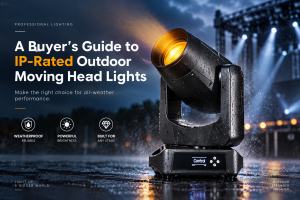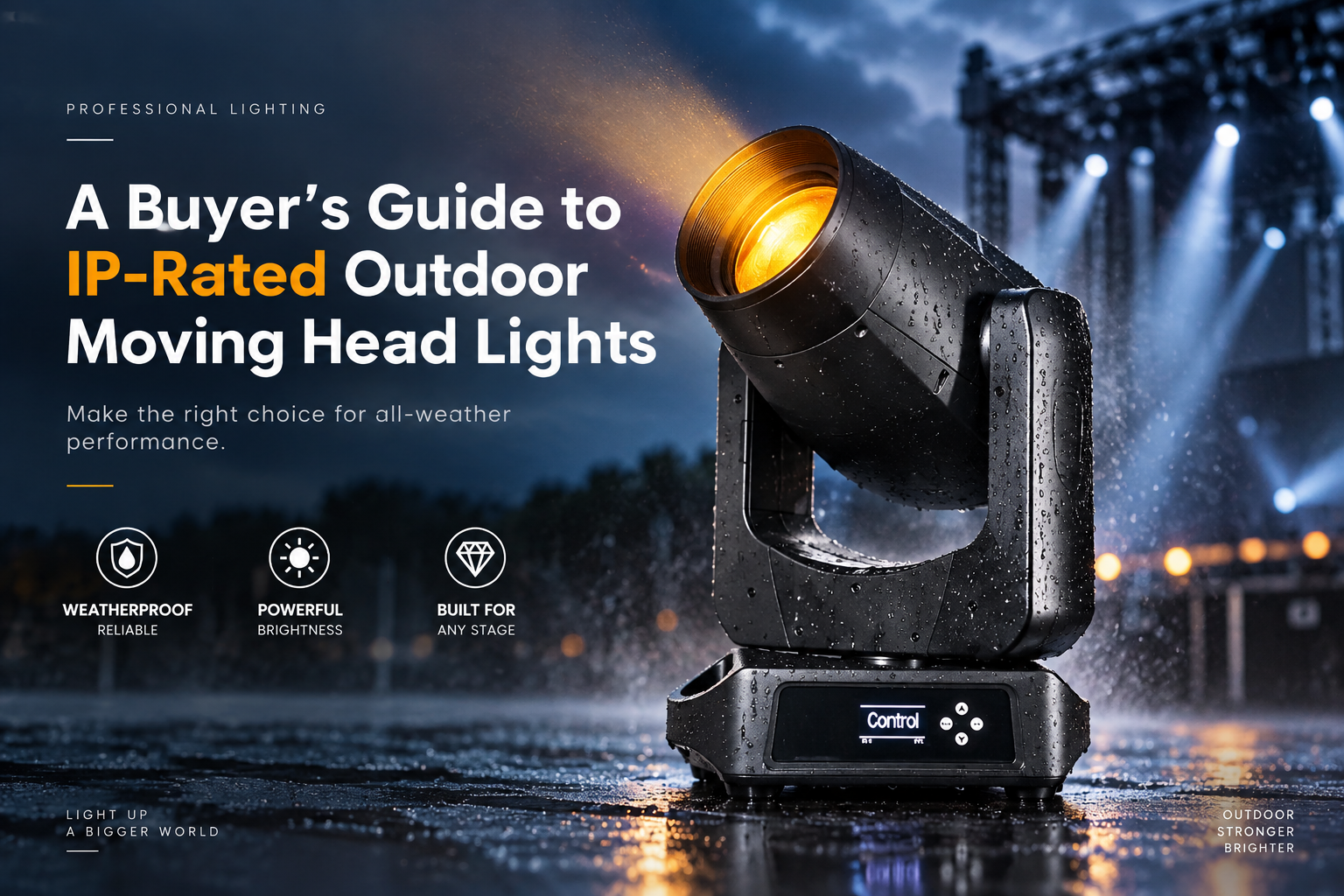
If you’re buying moving head lights for outdoor use, the IP rating is one of the most critical specs to evaluate — get it wrong, and you run the risk of a fogged lens or a dead motor after a heavy rain. This guide breaks down what IP ratings actually mean, how to tell a tested rating from a marketing claim, and what else to check before you commit your budget.
 What Is an IP Rating, and Why Does It Matter for Moving Head Lights?
 What Is an IP Rating, and Why Does It Matter for Moving Head Lights?
The IP rating is the standardized term for Ingress Protection. It is the absolute first specification professional buyers must check when considering any outdoor lighting equipment.
The standard IP code always consists of two specific digits. The first digit details the exact level of protection against solid objects like dust and sand, while the second digit defines the exact level of protection against liquids like rain and high-pressure water.
These numbers matter because they measure the physical barrier keeping those exact elements out. Moving head lights are packed with complex electronic boards and high-speed motors that require strict isolation. If that barrier fails and moisture or fine dust penetrates the housing, the fixture will immediately short-circuit.
Consequently, this IP barrier directly dictates your equipment’s outdoor survival and the successful execution of your entire lighting project.
IP54 vs. IP65 vs. IP66: Which Rating Do You Need?
Different lighting application scenarios require specific IP protection ratings. You must strictly match the appropriate protection numbers to the actual physical outdoor exposure your equipment will face.
For outdoor moving head lights, you will primarily choose between three industry standards: IP54, IP65, and IP66. Each rating provides a distinct level of environmental defense.
IP54: Best for Covered or Semi-Outdoor Use
IP54-rated moving head lights effectively prevent most harmful dust from accumulating internally and can resist water droplets splashed from all directions.
However, because they cannot withstand direct heavy rainfall, you must never expose fixtures with this rating to open weather. They are best suited for installation under solid roofs, inside covered tourist walkways, or on semi-outdoor cultural performance stages that possess clear physical overhead protection.
IP65: The Go-To Rating for Outdoor Events
IP65 serves as a common baseline for short-term, uncovered outdoor setups. In this specific code, the number “6” completely prevents all dust ingress, and the number “5” means the equipment resists low-pressure water jets from nozzles.
This means IP65-rated moving head lights can safely withstand temporary rain showers. Therefore, it is a practical option for seasonal festivals, pop-up events, or temporary stages that do not face year-round weather exposure.
IP66: For Uncovered, Long-Term Outdoor Installations
The IP66 rating provides a significantly higher level of liquid protection compared to the IP65 standard. It can withstand intense sprays of high-volume, high-pressure water columns and can even handle direct, brief impacts from sea waves.
If you need to execute a long-term permanent installation in a large theme park, for year-round mountain night tours, or on historical city walls exposed to severe weather, IP66 is the mandatory standard to ensure years of stable operation.
How to Verify an IP Rating Before You Buy
Do not simply trust the two IP digits printed on a product marketing brochure. You need to require the lighting supplier to provide specific scientific validation documents to support their parameter claims.
Ask for Third-Party Ingress Test Data
True industrial-grade outdoor moving head lights undergo rigorous testing by independent laboratories during their development phase. You can directly ask the manufacturer to produce the complete third-party watertight and airtight testing reports.
If the supplier can only offer a verbal promise or an internal testing declaration without any official laboratory certification documents, you must maintain a high level of caution regarding the actual waterproof performance of that equipment.
Check Whether the Rating Covers the Whole Fixture
Certain lighting manufacturers use wordplay in the fine print of their marketing materials. The high IP rating they advertise might only apply to the protected lamp housing section, entirely excluding the base or the control network ports.
You must explicitly ask the technical representative if the IP rating fully covers the entire moving head light, paying special attention to the highly vulnerable cooling fan systems, power input ports, and digital control panels.
What to Check Beyond the IP Number
The IP rating only represents the static physical ability of the equipment to resist dust and liquid. To ensure outdoor moving head lights operate stably for long periods in real environments, you must check other critical environmental adaptability metrics.
Operating Temperature Range
Outdoor lighting fixtures must be able to handle extreme environmental temperature shifts between day and night. You need to carefully review the lowest starting temperature and the highest operating temperature listed on the equipment specification sheet.
If the equipment operates in cold, high-latitude regions, it needs internal automatic heating functions to prevent the drive shafts from freezing. Conversely, if it operates in hot equatorial regions, a highly efficient convective cooling system is the critical configuration to prevent thermal degradation of electronic components.
UV and Corrosion Resistance
Long-term exposure to direct sunlight causes standard plastic components to become brittle rapidly and leads to severe fading of the external housing. Concurrently, high-moisture air rich in salt found in coastal areas quickly corrodes standard metal connectors.
Therefore, you must verify that the exterior paint of the fixture utilizes an industrial-grade anti-ultraviolet coating, and that all exposed external screws and suspension brackets are strictly manufactured from marine-grade stainless steel.
Cables and Connectors Need Matching Protection
If the external connection cables lack the equivalent level of waterproof capability, the IP rating of the main fixture body becomes entirely meaningless in practice. Rainwater will flow directly backward through the gaps in the cables and enter the internal control board.
You must ensure that all external power cables, data signal cables, and interface terminals possess an IP rating equal to or higher than the fixture itself, complete with physical locking sealing gaskets.
Common Buying Mistakes to Avoid
When purchasing large batches of outdoor moving head lights, buyers frequently make flawed budget decisions due to an insufficient understanding of the technical specifications. Here are three common errors you should actively avoid during your procurement process.
Choosing the Highest IP Rating Available
Selecting the highest IP rating on the supplier catalog, such as IP68, sounds like the safest physical choice. However, this level of over-configuration significantly increases the purchasing cost and the individual physical weight of the equipment.
Most standard outdoor performance and architectural environment lighting projects will never require the fixtures to be completely submerged in deep water pools for extended periods. Consequently, you must strictly match a reasonable rating to the actual geographic exposure environment, rather than purely chasing the highest number.
Skipping a Sample Test Before a Bulk Order
No matter how perfect the technical parameters appear on a paper specification sheet, they cannot truly demonstrate the long-term performance of complex equipment during real outdoor climate shifts.
Before signing a large-value purchasing contract, you must first buy or rent a sample unit to conduct a multi-week physical environmental exposure test. This process allows your technical team to discover potential sealing defects or cooling failures in advance, thereby preventing the complete failure of the entire system.
Buying Based on Price Alone
Purchasing cheap, standard indoor-grade fixtures and pairing them with temporary plastic rain covers seems to save a massive amount of purchasing funds at the start of a project. Yet, this practice completely ignores the total cost of ownership for the lighting system.
Looking at the long-term timeline, this cheap alternative will inevitably result in higher manual maintenance costs, show interruptions caused by unexpected equipment downtime, and voided warranty commitments due to improper usage. Natively configured outdoor fixtures are the only long-term investment that provides true commercial value.
Further reading: LED PAR Lights vs Moving Head Lights: Which One Should You Choose?
Dasen Lighting’s Top Picks: IP-Rated Moving Heads Built to Last
If you need a verified outdoor solution, the Dasen Lighting Imager H 280 is our primary recommendation for cultural tourism projects and permanent installations.
This specific fixture carries a certified IP66 rating. This code guarantees the unit completely blocks dust and withstands high-pressure water jets. Because of this robust barrier, you can securely install the Imager H 280 outdoors year-round without facing internal motor failures caused by water ingress.
Beyond its strict physical protection, this model features a 280-watt LED source configured as a Beam, Spot, and Wash hybrid system. It incorporates CMY color mixing and a patented four-color wheel to deliver exact color outputs across a 3° to 33° beam angle. Furthermore, the equipment provides 13 fixed gobos and 9 rotating gobos, offering complete optical control for large-scale architectural illuminations or outdoor live-action theaters.
Therefore, the Imager H 280 successfully combines the extreme weatherproofing and the specific physical lighting tools required to execute your professional outdoor projects.
Secure Your Outdoor Lighting Investment
Ultimately, selecting the correct IP rating is the foundation of any successful outdoor lighting project. Matching the physical barrier to your exact environmental exposure prevents critical equipment failures and long-term budget overruns.
Why let unpredictable weather dictate your lighting design? If you need a fully weatherproof solution, the Dasen Lighting Imager H 280 provides certified IP66 protection and exceptional optical control. Contact us today to discuss your specific cultural tourism project and take the risk out of your next outdoor installation.