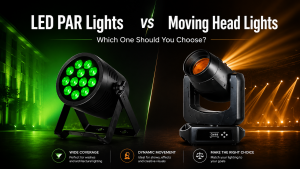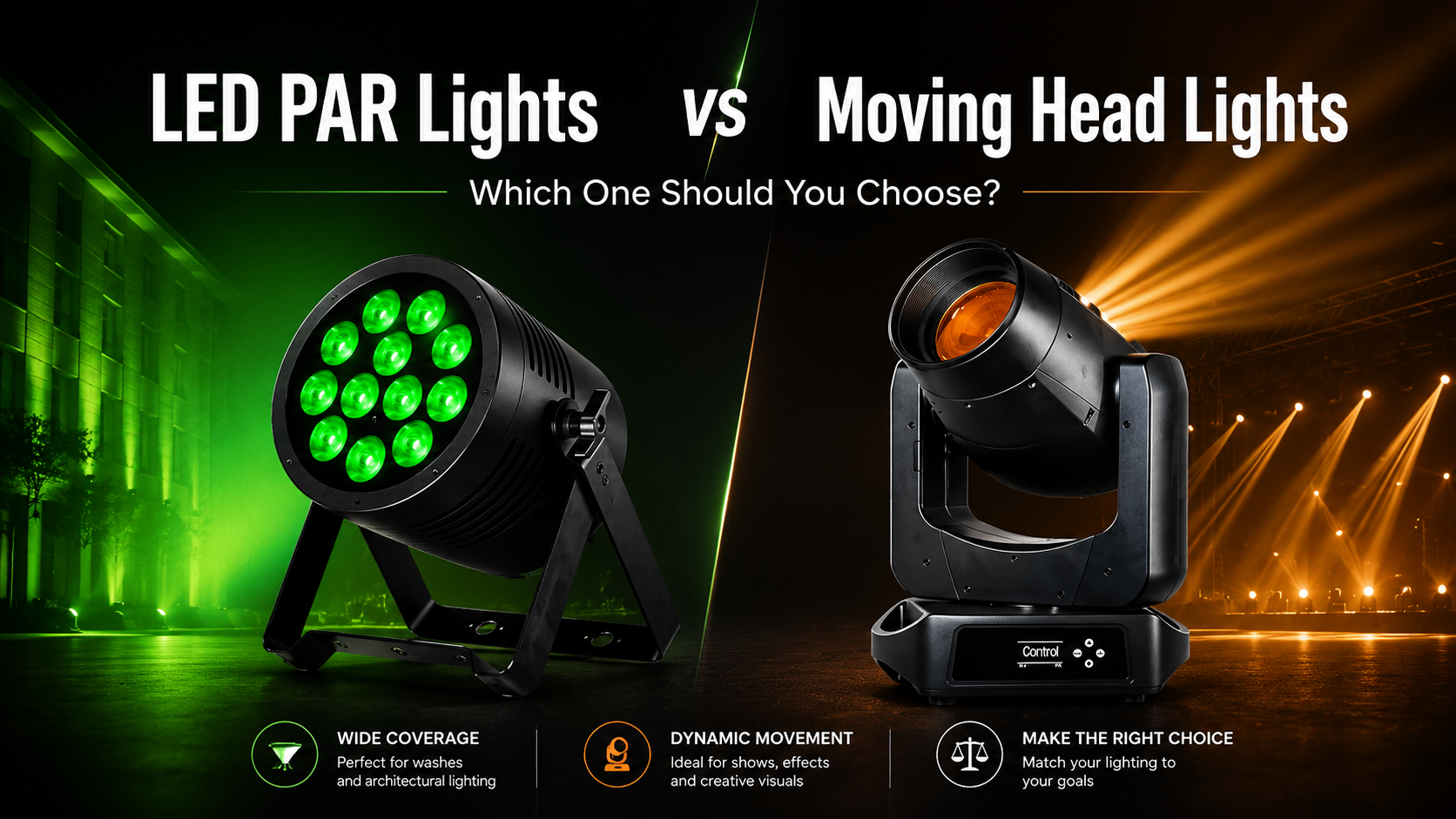
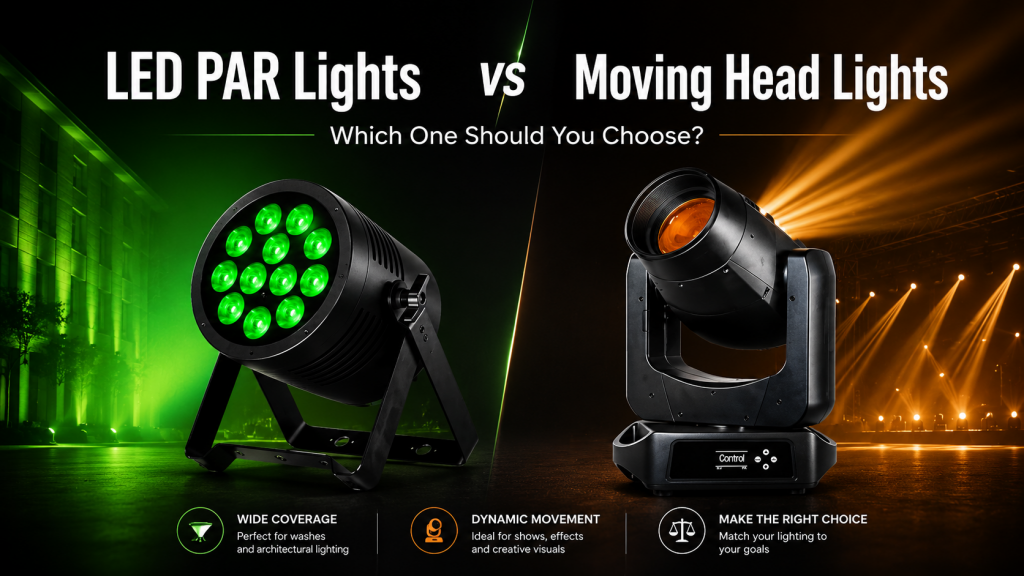
Choosing between LED PAR lights and moving head lights depends on the lighting effects, venue size, installation environment, and control flexibility your project requires. LED PAR lights are ideal for stable, wide-area color washes, while moving head lights deliver dynamic movement and more complex visual effects. This guide compares their performance, cost, maintenance, and best applications to help you choose the right fixture.
What Are LED PAR Lights?
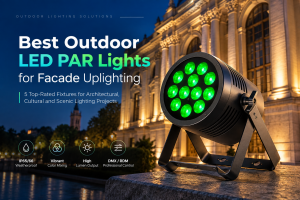
An LED PAR light is a fixed-position fixture. It uses a parabolic reflector to project a wide, even wash of colored light across a space.
Key Features: Each fixture houses clustered RGBW or RGBWA-UV LEDs behind a parabolic reflector, which blends the individual LED colors into a single, uniform wash. There are no moving parts, so the beam stays fixed once the unit is aimed and mounted.
Advantages:
- Lower unit cost than motorized fixtures
- No programming or calibration needed
- Silent operation, with no motors or fans
- Low heat output
- Long LED lifespan, reducing replacement frequency
Disadvantages:
- No beam movement once installed
- No gobo or pattern projection
- Limited visual variety
- Fixed beam angle after installation
What Are Moving Head Lights?
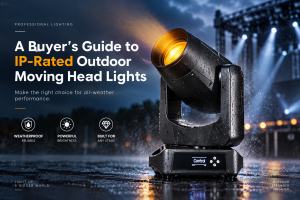
A moving head light is a motorized fixture. Its pan/tilt head repositions the beam across a space in real time.
Key Features: A motor-driven pan/tilt mechanism moves the light head on two axes, while built-in gobos, prisms, and zoom control reshape the beam as it moves. Together, these components let a single fixture generate multiple looks across multiple locations.
Advantages:
- Real-time beam movement and repositioning
- Covers multiple zones from one fixture
- Strong visual impact from movement and effects
- Multi-functional, switching between spot, wash, and beam
- High versatility for choreographed shows
Disadvantages:
- Higher unit cost
- Heavier and harder to rig
- Steeper programming curve
- More frequent maintenance due to motors
- Louder operation from fans and motors
LED PAR Lights vs Moving Head Lights: Side-by-Side Comparison
Choosing between the two fixture types comes down to eight technical factors. Each one affects a different part of the buying decision, from visual output to installation logistics.
- Effect Versatility:How many distinct looks a fixture can produce, including color changes, movement, and pattern projection. A static fixture needs one unit per area, while a moving fixture can cover several areas on its own, reducing total fixture count.
- Max Lumen:The fixture’s brightness output, measured in lumens. Outdoor sites and large venues need higher lumen output to stay visible against daylight, while smaller indoor spaces can use lower-lumen fixtures without losing impact.
- Control Protocol:How the fixture is operated — standalone, via DMX, or through wireless control. A standalone fixture runs without a controller, while a DMX-driven fixture needs a console and cabling, adding setup cost.
- Power Draw:How much electricity a fixture consumes. Lower power draw allows more fixtures per circuit, which matters when wiring multiple units across a site with limited electrical capacity.
- Weight: The physical weight of the fixture. Heavier fixtures require rated mounting hardware, which becomes a safety concern when installing on facades, ceilings, or other overhead structures.
- Cooling:How a fixture dissipates heat, either passively or through fans. Passive cooling stays silent, suiting quiet indoor settings, while fan-based cooling manages heat better but adds noise.
- DMX Channels: The number of DMX channels a fixture uses to control its functions. Fewer channels keep programming simple, while more channels allow finer control over movement and effects but require a larger console.
- IP Rating: A fixture’s resistance to dust and water. An IP65-rated fixture, for example, withstands water jets from any direction and suits direct outdoor exposure, while a fixture rated below IP65 is generally limited to indoor or sheltered use.
These factors define what to look for in a fixture spec sheet, and the table below summarizes how the two types typically compare on each one.
| Criteria | LED PAR Lights | Moving Head Lights |
| Effect Versatility | Fixed color wash only | Movement, gobos, prisms, zoom |
| Max Lumen | Typically lower, suited to ambient wash | Typically higher, suited to focused beams |
| Control Protocol | DMX or standalone/auto modes | DMX-driven, often with wireless options |
| Power Draw | Lower, due to simpler components | Higher, due to motors and fans |
| Weight | Lighter, easier to mount | Heavier, requires stronger rigging |
| Cooling | Passive cooling, silent operation | Active cooling with fans, generates noise |
| DMX Channels | Fewer channels, simpler programming | More channels, more complex programming |
| IP Rating | Varies by model; IP65+ needed for outdoor use | |
How to Choose Between LED PAR Lights and Moving Head Lights
Three factors decide which fixture fits a project: budget relative to effect needs, venue size, and available maintenance support. Each one narrows the choice from a different angle.
Price Usually Reflects Effect Versatility
Price differences between the two fixture types aren’t arbitrary — they track directly with what each fixture can do. LED PAR lights stay affordable because they focus on a single function: producing a static color wash. Moving head lights cost more because motorized movement, gobos, and zoom optics add both components and engineering complexity.
This means the budget question really comes down to necessity. If a project only needs ambiance or a consistent color backdrop, paying for movement capability adds cost without adding value. If dynamic effects are central to the experience, the added cost of a moving head becomes justified rather than excessive.
Venue Size and Coverage Needs Affect Fixture Value
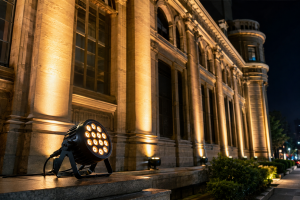
Venue size changes how much value a moving fixture provides. LED PAR lights work well when a single fixed area needs illumination — a facade, a garden bed, a lobby wall. Because the beam doesn’t move, one fixture covers one zone.
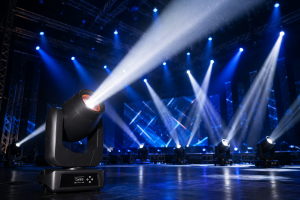
Moving heads work differently: a single fixture can redirect its beam to cover multiple zones over time. This matters most in larger or multi-purpose venues, where using several moving heads instead of many static PAR lights can reduce the total fixture count while still covering every area.
Maintenance Capacity Should Influence Fixture Selection
Fixture choice should also account for who will maintain it. LED PAR lights have no motors or moving parts, so they need minimal upkeep beyond basic cleaning and occasional LED replacement.
Moving heads rely on motors, fans, and mechanical effect systems, all of which wear over time and require periodic servicing. A venue with a dedicated technical team can absorb this maintenance load without issue. A venue without that support — a small museum or heritage site, for example — may find that simpler PAR fixtures hold up better over the long term, even if they sacrifice some visual range.
Taken together, these three factors point to the same conclusion: the right fixture depends less on which one performs “better” and more on which one matches the project’s budget, scale, and long-term maintenance capacity.
Best Applications for LED PAR Lights and Moving Head Lights
The two fixture types suit different settings based on the factors covered above. The lists below outline where each one typically fits best.
LED PAR Lights
- Heritage Building Facade Lighting
- Museum and Exhibition Ambient Lighting
- Garden and Courtyard Uplighting
- Cultural Center Lobbies and Reception Areas
- Historic Street and Pathway Accent Lighting
- Visitor Centers and Retail Ambiance
Moving Head Lights
- Night Tour Light Shows
- Themed Attraction Effects
- Festivals and Cultural Events
- Heritage Site Sound-and-Light Shows
- Cultural Park Nighttime Entertainment
- Theatrical and Live Performances
Which Dasen Lighting Fixture Fits Your Project?
For projects that need both a stable wash and detailed pattern work, Dasen Lighting offers two fixtures worth considering.
YX-040P-6C
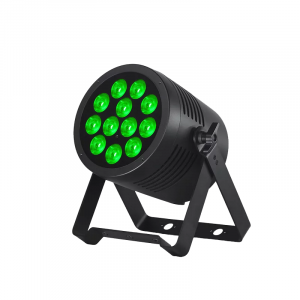
The YX-040P-6C is built for facades, gardens, and pathway accents. It carries an IP65 rating and operates across -20°C to +45°C, holding up under year-round outdoor exposure. Its beam angle is available in 25° or 40°, making it easy to match coverage to a specific wall or courtyard.
Imager H 280
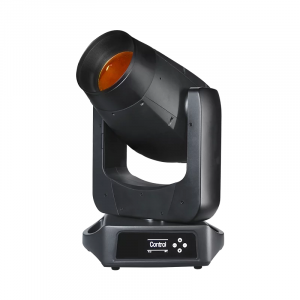
For projects that call for pattern effects, the Imager H 280 runs on a 280W LED source with a 3° to 30° zoom range, giving it strong versatility for detailed gobo work. Its library includes 13+1 fixed and 9+1 rotating gobos, and it carries the same IP66 protection for reliable outdoor performance.
Used together, the two fixtures cover both ends of a lighting plan — steady ambient wash from the YX-040P-6C, and detailed, repositionable pattern effects from the Imager H 280.
Bring Your Lighting Vision to Life
Choosing between LED PAR lights and moving head lights comes down to what a project actually needs — steady ambiance or dynamic movement. Dasen Lighting’s YX-040P-6C and Imager H 280 cover both, built for reliable outdoor performance across cultural sites, landscapes, and live shows.
Ready to light up your next project? Contact Dasen Lighting today for tailored recommendations and a quote.
FAQ
Q1: For heritage building facades and outdoor landscape lighting, what IP rating should I look for in an LED PAR light?
IP65 is generally the minimum for outdoor use — it protects against dust and water jets from any direction, enough to handle rain and humidity year-round. Fixtures below IP65 are typically meant for indoor or sheltered use only.
Dasen Lighting’s YX-040P-6C, for example, is IP65-rated with an operating range of -20°C to +45°C, suited to year-round outdoor installation.
Q2: What should I check before installing moving head lights at an outdoor site?
Three specs matter most: IP rating (IP65+ for direct weather exposure), LED lifespan, and heat dissipation design, since outdoor fixtures can’t rely on climate control.
Dasen Lighting’s Imager H 280 illustrates this profile — IP66-rated with a -20°C to +45°C operating range, built for semi-permanent outdoor use.
Q3: How do I estimate how many fixtures are needed to light a multi-zone cultural site?
Start by mapping the site into zones — facades, pathways, indoor exhibits, performance areas — since coverage needs differ by zone. Wide static zones need fewer, wider-beam fixtures; a single show area can often run on one or two adjustable fixtures instead of many fixed units.
For instance, a wide-beam PAR like the YX-040P-6C (25°/40° optional) suits facade washes, while a zoom moving head like the Imager H 280 (3°–30°) covers a show area with multiple looks from one fixture.